
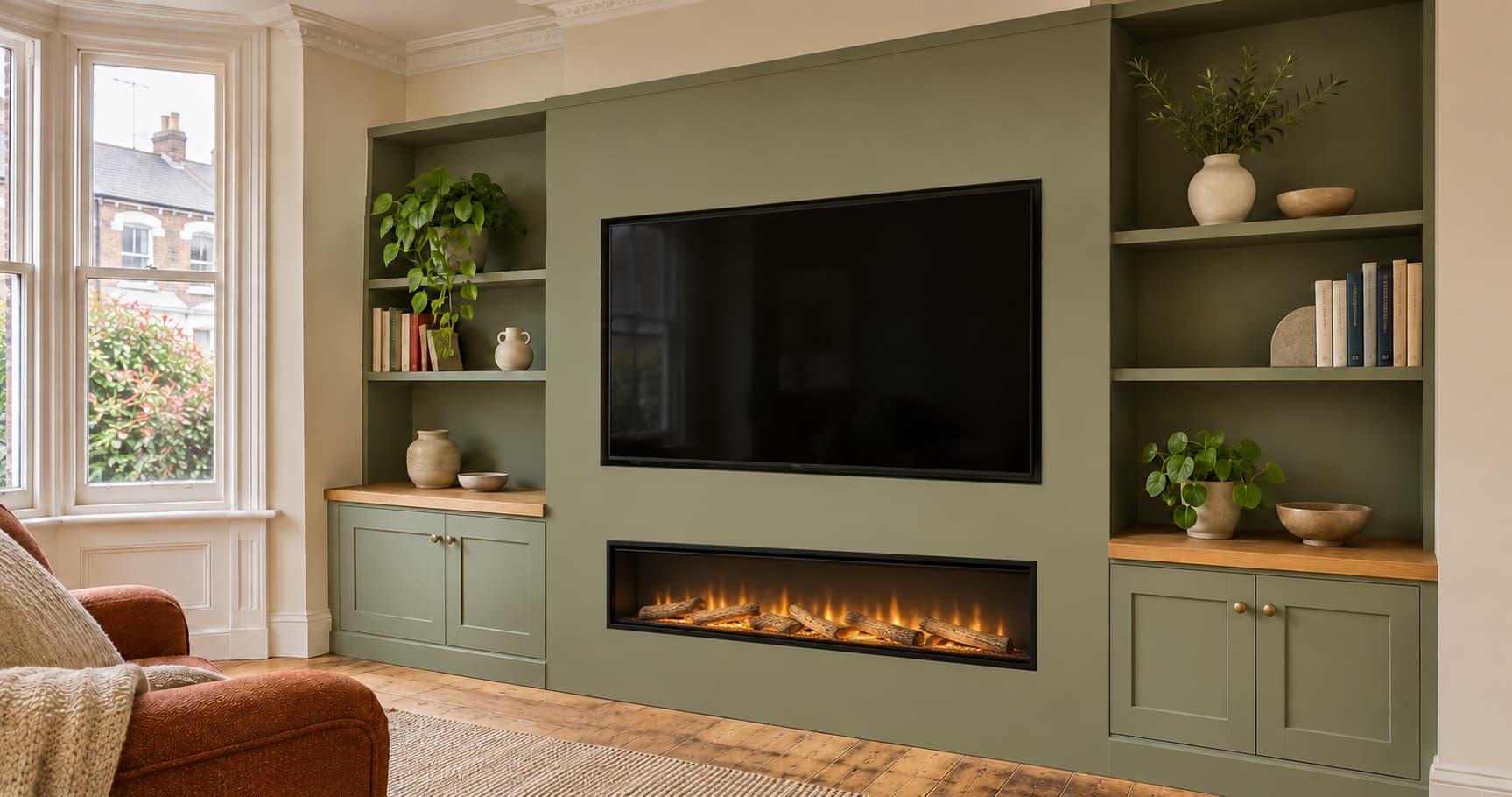
Buy the fire first. Every good media wall with electric fire starts there, because the frame, the recess and even the TV size all get built around it. Swap a TV later and nobody notices. Swap a fire that doesn’t fit and you’re cutting into a finished wall.
This guide walks through picking the fire, getting the proportions right, keeping the TV safe from heat and sorting the electrics before the build starts.
Planning your wall now? Get free quotes from vetted media wall installers.
Inset or wall-mounted: which fire suits a media wall?
There are two main routes.
Inset fires (also called recessed or hole-in-the-wall fires) sit inside a recess so the glass is flush with the wall. This is the classic media wall look. It needs a recess built to the exact size in the fire’s manual, so planning matters.
Wall-mounted fires hang on the face of the wall, a bit like a picture. The build is simpler and cheaper, but the fire stands proud of the wall instead of sitting flush.
| Inset fire | Wall-mounted fire | |
|---|---|---|
| Look | Flush, built-in | Sits on the wall surface |
| Build | Needs an exact recess | Simpler frame |
| Best for | Full-height feature walls | Budget builds or existing walls |
Sizing a media wall with electric fire and TV
Media wall fires usually come in widths from 36 to 72 inches. The rule most fitters follow: the fire should match the TV’s width or go wider, never narrower. A fire slightly wider than the TV is the most popular layout.
For a neat finish, some people build the TV recess to the same width as the fire, then pick a TV that fills it. If you’re planning a media wall with electric fire around a 65-inch TV, look at fires of 65 inches and up.
Two more things to measure before ordering:
- TV height. Too high and you’ll be craning your neck from the sofa. Sit down, look ahead, and note where your eyes land.
- Wall depth. Inset fires need a set depth behind them, so the frame has to stand far enough off the original wall.
One, two or three-sided fires
A front-facing fire is the simplest and cheapest to build around. A two-sided fire suits a wall that ends at a corner or alcove. A three-sided (panoramic) fire shows flames from the front and both ends, so it needs a wall that sticks out into the room.
The more sides, the more glass and the more precise the build. Expect a higher price for both the fire and the joinery.
Not sure which suits your room? Ask a local installer for a free quote and get advice before you buy.
Heat, TV clearance and running costs
Most media wall fires put out 1kW to 2kW of heat. That’s enough to take the chill off a living room, but it won’t replace your central heating. Most also have a flame-only setting for ambience without heat.
Every fire comes with a minimum gap to anything above it, your TV included. Follow that figure exactly. Electric fires send far less heat upwards than gas or wood fires, which is why the TV-above-fire layout works, but the manufacturer’s gap is still the one to build to.
Running costs are easy to work out: the fire’s kW rating multiplied by your electricity unit rate. A 2kW fire on full heat costs roughly 50p to 55p an hour at recent Ofgem price cap rates. Flame-only mode costs pennies.
Electrics behind a media wall with electric fire
Get the wiring planned before the boards go on. Once the wall is plastered, adding a socket means cutting into your new finish.
A typical media wall with electric fire needs:
- A socket or fused spur for the fire, placed where the manual says
- Sockets behind the TV, plus spares for a soundbar, games console or streaming box
- Aerial and network points brought into the wall
- Wiring for any LED strips or downlights
All home electrical work has to meet Part P of the Building Regulations. In England, adding sockets to an existing circuit isn’t notifiable unless it’s near a bath or shower. A brand-new circuit is notifiable, and a registered electrician can self-certify it. The Planning Portal lists exactly what counts. If your fire is hardwired rather than plugged in, it needs a qualified electrician to connect it.
Need an electrician as well as a joiner? Find vetted installers on TradeWatch for free.
Before you book an installer
Take these to every quote:
- Have you built around this fire model before, and will you work to its manual?
- Who does the electrics, and are they registered with a competent person scheme?
- Will the TV recess have room for an extending bracket, so cables are easy to reach later?
- Does the quote include the fire, TV mounting and finishing, or just the frame?
- Can I see proof of public liability insurance?
Want the full price breakdown? Our media wall cost guide covers basic, mid-range and high-end builds.
Ready to build? Get your free media wall quotes now.
Media wall with electric fire FAQs
How much does a media wall with electric fire cost?
Most professionally built walls with an inset electric fire cost between £2,000 and £4,500. Basic builds start around £1,200, and high-end walls can pass £10,000.
Can you put an electric fire under a TV?
Yes, as long as you keep to the minimum gap in the fire’s manual. Electric fires release far less heat upwards than gas or wood fires.
Will a media wall fire heat my room?
It’ll warm a small or medium room, but most only put out 1kW to 2kW. Treat it as top-up heat on cold evenings.
Do electric fires for media walls need a chimney?
No. Electric fires don’t produce smoke or fumes, so they need no flue or chimney. That’s what lets you put one on almost any wall.
Can I plug a media wall fire into a normal socket?
Many plug into a standard 13A socket. Some larger models are hardwired, which needs an electrician. Check the fire’s spec before you plan the wiring.
Find a vetted media wall installer near you. Get free quotes on TradeWatch.